The Dying and the Hidden Death
The Greatest Beer Run Ever: A Memoir of Friendship, Loyalty, and WarThe world of the dying names the altered reality that opens when a person’s death becomes more than a distant possibility: ordinary life, still proceeding around them, can appear newly precious and painfully inaccessible. In the account of Susan McGahern’s illness, this idea also takes domestic form. A child imagines recovery in the coming holidays while the adults around his mother continue to hope; against those hopes, the narrative sets the difficulty of speaking plainly about death and the loneliness of the person who is dying.
A Changed View of Ordinary Life
Before illness makes death immediate, people may briefly wonder what form it will take—age, accident, stroke, or cancer—and then turn back to the demands of the day. Once that feared time arrives, however, ordinary activity changes its meaning. A waitress pouring coffee, a builder laying blocks, a girl opening a window, or men collecting refuse belong to a world that the dying person may once have barely noticed. Now it can seem like a place of happiness that cannot be reached, even in its most modest forms. The emphasis falls not on extraordinary scenes but on the daily continuity from which the dying are becoming separated.
The reflection invokes the words of Achilles to Odysseus: the dead would prefer earthly life, even in the condition of a penniless man’s servant, to sovereignty among the dead. The comparison makes continued life valuable without pretending that it is comfortable or grand. Its force comes from the lowliness of what is desired: participation in the world at all. From this perspective, the ordinary tasks and passing encounters around Susan do not become trivial because her illness interrupts them. They become newly visible as forms of life she may lose.
The Social Concealment of Death
The dying are marked both by their own knowledge and by the world they are losing. Their presence also unsettles the appearance that life continues indefinitely. For everyone else, daily business goes on; for the dying, it does not go on in the same way. The account describes the resulting pressure to hide, obscure, or deny what is happening. Plans are rarely made openly around the person who will not be there, and this silence can make practical arrangements seem ruthlessly efficient even when no one intends cruelty.
Direct speech about death is correspondingly restricted. The collision between what is inevitable and what remains almost unimaginable can sometimes be expressed as a joke, where laughter briefly holds the two together. Pious consolations offer no equivalent openness: they are described as a coating of dust or chaff, covering rather than addressing the truth. The concept therefore concerns more than private fear. It also describes a social habit of carrying on as if the approaching loss could be kept outside the shared world by not naming it.
Susan McGahern’s Illness at Home
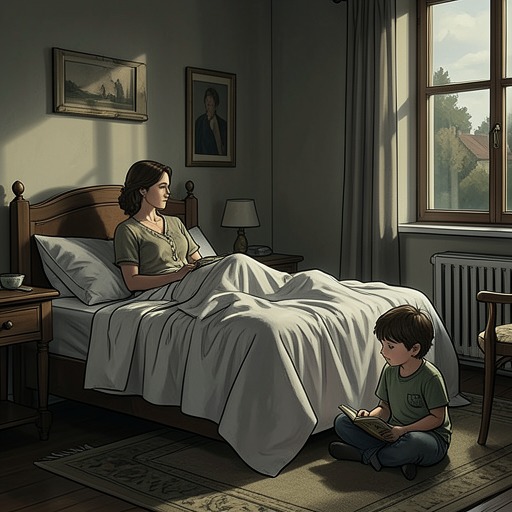
Susan’s illness gives these reflections their immediate human setting. Her brother Uncle Pat visits almost every day and climbs the stairs to her room, coughing as he crosses the narrow wooden corridor. He stops at the bedroom door and asks after the patient. Susan generally says that she is improved or a little better, and this reassures him. He points to the coming summer, good weather, and the time recovery may take. Their affection is evident in the ritual of his visits, but its hopeful repetition cannot guarantee the future it describes.
On one visit Susan answers differently. She says she is not doing so well, that sometimes she thinks she will never get out of this, and that she does not know what will happen. Uncle Pat is shaken into silence, clearing his throat several times before urging her not to think that way. Susan does not claim to want to give up; she says that sometimes events are not in one’s hands. The exchange briefly allows uncertainty into a routine built around reassurance. His response attempts to restore hope, while her answer registers the limits of what hope can control.
The account also refuses to treat faith as an uncomplicated protection. Susan’s faith may have been a strength, yet her husband uses it against her by accusing her of losing faith in God. Whatever comfort faith provides, it cannot remove the human pain of losing the people who depend on her and whom she loves. After forty-two years in a world where many loved her, she has no one to whom she can communicate the full weight of that loss. The problem is not simply that others fail to care for her; care and affection are present, but they do not by themselves bridge the isolation of her experience.
A Child’s Refusal and the Limits of Hope
The child narrator initially answers illness with a future made of familiar promises. He imagines that his mother will return to school after the holidays and that they will walk together again past Brady’s pool and house, the Mahon brothers’ street, the dark quarry, and the railway bridge. These named landmarks give recovery a route through a recognizable landscape. The school substitute and the long summer holidays seem to leave ample time for her to get better. In the child’s reasoning, the calendar and the walk home become evidence that ordinary life will resume.
An older girl’s questions break into that imagined future. She asks what would happen if Susan did not recover, and then asks what if she died. The narrator insists that his mother cannot die because she is too young; the girl answers that her own mother died young and that she had to leave school before she was fourteen. Her experience makes death possible at an age the child had treated as a guarantee. The narrator still rejects the possibility, but the questions follow him as he descends the railway track. He sits on a sleeper, puts his head in his arms, and feels indifferent to whether a train is coming. The scene does not resolve his fear; it gives that fear a physical place beside the route that had represented a hoped-for return to school and health.
Narrative Significance
The concept holds together the difference between outward continuity and inward rupture. Around Susan, school arrangements are made, visitors arrive, and the children continue to imagine the holidays. In the child’s understanding, these ordinary events support the belief that his mother will recover. The reflective account, by contrast, shows how the same continuity can expose what the dying person is losing. The gap between those perspectives is not closed by reassurance, faith, or affection, though all are present in the family’s life.
By moving between general reflection and particular encounters, the narrative makes the concealment of death visible without suggesting that every silence has the same cause. The child cannot accept what the older girl asks him to consider; Uncle Pat answers Susan’s admission with renewed encouragement; and the account of Susan’s faith recognizes both its strength and its limits. Together, these moments show how people approach an approaching death through different forms of hope and avoidance. The world of the dying is distinct not because the living cease to care, but because care cannot make the threatened loss equally knowable to everyone.